
Who actually takes care of office plants?
There is a whole trade that does nothing but keep plants alive indoors, and it is easy to work in an office for years without hearing about it. Here is who does the work, what happens on a visit, and what to ask the company that comes to your floor.
Last updated: September 2026 · Written by Augustin and Luca, the family behind Area Indoor Plants, interior plantscapers in Los Angeles and Orange County since 1986.
The short answer: an interior plant service
Office plants are looked after by an interior plant service: a company whose entire business is keeping plants alive indoors. A named technician comes to your building on a fixed schedule and waters, feeds, prunes, cleans and inspects every plant, whether or not anyone in the office has noticed a problem. It is a route business, so the same technician usually works the same buildings on the same day, and your office is one stop on a run.
The trade calls this interior plantscaping, or interiorscaping. It is not gardening and it is not cleaning. It is horticulture done in containers, under office light, in a building that sits empty two days out of every seven.
It is easy to miss that the trade exists at all. A plant arrives with a move-in, somebody waters it for a while, it starts to go, and only then does anyone wonder whether companies do this for a living. They do. Our own service page covers what a program includes.
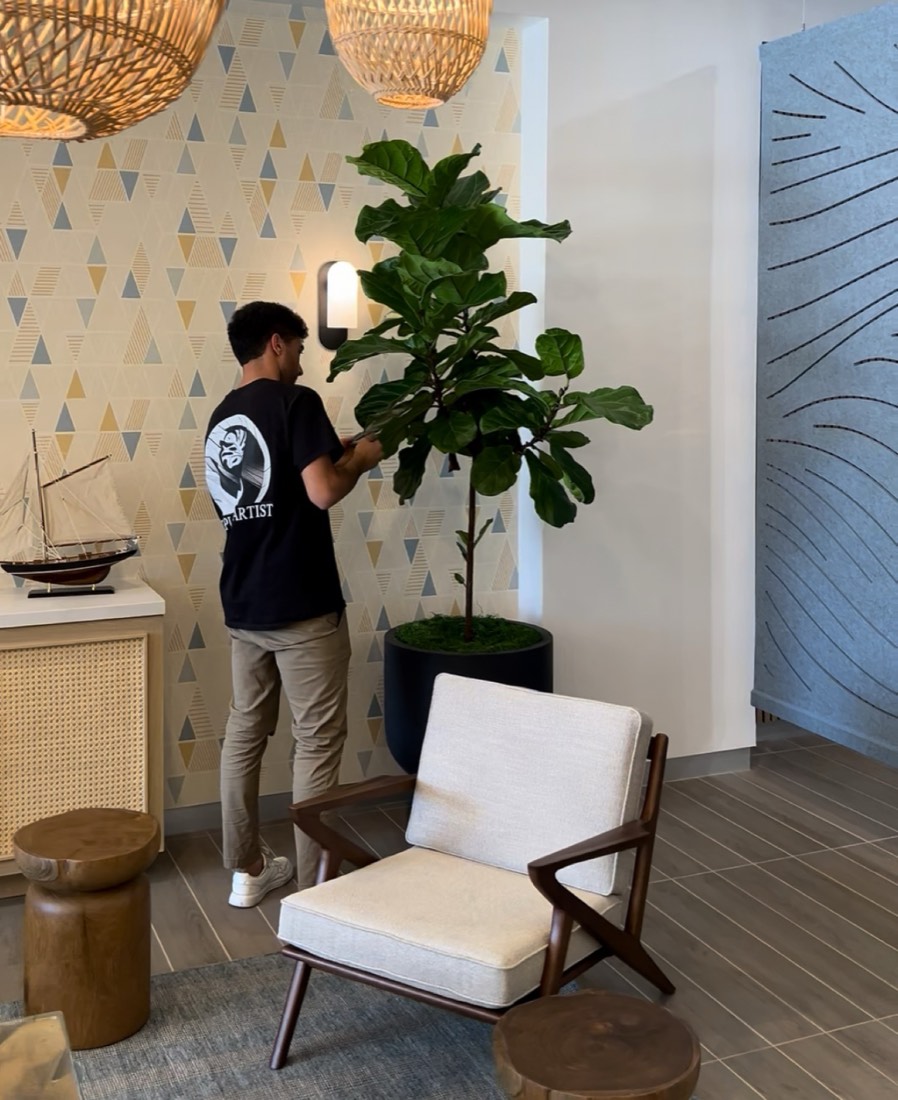
The four people who end up doing it
In practice the job lands on one of four people. Each is genuinely good at something, and each runs out of road at a point you can predict.
- Someone in the office who likes plants. They are on site every day, they notice things early, and they cost nothing. What they cannot do is the rest of the job: feeding, pruning, repotting, treating a pest, reaching the top of a tree on a ladder. And the arrangement ends the day they take a holiday, move desks or take another job. The plants do not know that the person who was watering them has gone.
- The cleaning crew. They are already in the building, on a schedule nobody has to chase. The trouble is that they were hired to clean, and so every pot gets a pour, including the ones that are still wet from last time. Nobody is checking whether a plant is dry. Nobody is feeding it, and nobody is turning a leaf over to look underneath. That is not a failing of the crew. It is a different job.
- The landscaper who does the outside. This one is tempting: one vendor, one bill, and they clearly know plants. But outdoors and indoors are separate trades. Outside, a plant gets rain, real sun, soil that drains and a season it recognizes. Inside, it lives in a container with no drainage hole, in dry air, under light that was designed for reading. That gap is the whole subject of our piece on what is actually going wrong when office plants die in an LA office.
- An interior plant service. The difference is not skill alone. It is that the plants become somebody's job, on a fixed date, with their name attached to how they look. Be straight about the limits. It is a line item, it is only as good as the visits, and a route that has gone stale looks like one that is working until you walk over and look at the plants. Judge it the way you would judge any other vendor: by what changed between one visit and the next.
Whether the fourth option is worth paying for at your plant count is a separate question with an honest answer, and we work the arithmetic out loud in our comparison of hiring a service against watering them yourselves.
What happens on a visit, minute by minute
Here is what a visit actually looks like. Crews start at 6am. The early start is deliberate: a technician can work a lobby and an open floor before the desks fill up, with no cart in anyone's way and no ladder over anyone's head.
The first thing that happens is not watering. It is a walk of the floor with empty hands, looking for what changed since last time. A plant that has been moved. A blind that is now kept closed. A new desk parked under a supply vent. A container somebody has been emptying coffee into. A route technician reads the room before reading the plants, because the room decides what a plant can do, and the room is what changes.
Then the same order at every plant, so nothing gets skipped. Soil checked before anything is poured, feed, prune, wipe the leaves, and turn a few over to look underneath. The order is the point. It is why the plant that is quietly dry in week one never becomes the plant that is dead in week six. The care guide sets out what each of those steps actually involves.
How long does all of that take? Less than people expect. A training piece in the trade called One Minute Maintenance puts a trained technician at no more than about one minute per plant, with individual steps running five to fifteen seconds. An operator on a trade forum described the same thing from the other end: a 315-plant account serviced weekly in five hours, which works out to roughly 0.95 minutes a plant.
The caveat matters as much as the figure. That is a trained technician's time, on plants that were chosen and installed so they could be serviced fast, and it leaves out travel, ladder work, replacements and spraying. It is not the time it takes an employee with a watering can, and the operator who published the number said so explicitly.
The minute is also not where the value sits. The pour is the cheap part. What you are paying for is a trained person putting eyes on every plant you own, on a known date, and making the calls that stay invisible until they get expensive: this one is in the wrong place, this one is rootbound, this one is two weeks from being past saving and has to come out now.
Sources: "One Minute Maintenance" by Linnaea Newman, plantpaws.com; a route operator's account of a 315-plant weekly account, forum.interiorscape.com, June 2011.
Weekly or every other week: 52 or 26 visits a year
Service comes on one of two rhythms. Weekly is 52 visits a year. Every other week is 26. It is worth knowing which one your office pays for, because "regular service" and "twice monthly" are not the same thing as either. Crews start at 6am on both.
Four things decide which one a space needs.
- How many plants there are. The more plants on the floor, the higher the chance that something is dry on any given day, and the shorter the gap you can safely leave between checks.
- The light. A bright spot grows faster and dries faster, and it needs more pruning as well as more water. Bright floors push toward weekly. A dim corridor of ZZ plants and sansevieria will hold on every other week, which is one reason species have to be matched to the light before anything is ordered.
- Container size. A large floor container holds a reservoir that lasts. A shelf of small pots does not. A space full of small pots is usually a weekly space no matter how few plants are in it.
- How fast the room dries. Dry air, a supply vent, west-facing glass in the afternoon, a lobby door standing open all day. If the room pulls water out of a pot quickly, the schedule has to keep up with the room.
Where the plant in your lobby came from
Here is the part of the business nobody explains. The plant in your lobby did not come from a store. It was grown at a nursery in far more light than your office will ever have, and then it was acclimated: stepped down toward interior light in stages, over a long stretch, so it can hold its leaves in a room instead of dropping them in the first month. A plant that skipped that step looks superb on delivery day and starts dropping leaves soon after.
Where a service buys its plants matters more than it sounds, and it is a fair thing to ask.
And when a plant does come out? On a Guarantee plan the replacement is free. On a plan without it, a replacement is a plant you buy.

What the guarantee does, and what it does not
On our Guarantee plans, any plant that declines is replaced free. No replacement fee, and no service call to book. The thing to be clear about is which plan it is attached to: free replacement comes with the two Guarantee plans, not with plain Every-Other-Week or plain Weekly service. When you read anyone's guarantee, the question is not whether the word appears on the page. It is which plan carries it.
What a guarantee settles is who pays when a plant goes. It is not a promise that nothing will ever decline, and it is not a fix for a bad spot. A guarantee replaces the plant. It does not change the light. If the same corner takes a second plant, the answer is to move it or change the species, and a service worth its rate will say so instead of quietly sending a third.
Plants you already own are handled the same way. They are assessed at the walk-through, and if they can be taken on under a Guarantee plan, the proposal says so. Anything already failing is quoted for replacement up front, not quietly counted as covered.
What to ask the company that services your office
If you pass this along, these are the things worth asking, whether the company already comes or is about to.
- Which plan does the guarantee come with? Ask for the plan name, not the reassurance. On our four plans, free replacement is on the two Guarantee plans only.
- How many visits a year is that? Weekly is 52 and every other week is 26. Anything else is a description of a schedule rather than a schedule.
- Will the same technician come every time? A technician who has your floor on their route notices what changed since last week. Someone seeing the room for the first time can only see it as it is today.
- What happens to the plants we already have? The right answer is that they get assessed at the walk-through, the ones worth keeping are named, and the ones already failing are quoted up front. If you are leaving another company, here is how a changeover works without your planters sitting empty in between.
Money is its own list and it has its own page. Our breakdown of what office plants cost in Los Angeles sets out how two bids come to differ.
If you just want to know what is wrong with yours
Send a photo of the plant that made you look this up, and we will tell you what it is, what is going wrong and what it would take to keep it, whether or not you ever hire anyone. The form is just below.
Send us a photo
Tell us about the space and send a few pictures. We will tell you what we see, what would fix it, and roughly what a service costs. No visit needed.
You will hear back from a real person by the end of the next business day.