
Office plants dying? What's actually going wrong in an LA office
Most office plants do not die of a disease. They die of the room they were put in, and you can usually work out which part of the room did it.
Last updated: September 2026 · Written by Augustin and Luca, the family behind Area Indoor Plants, interior plantscapers in Los Angeles and Orange County since 1986.
Start with the symptom and work backwards
You are standing in front of it right now. The lower leaves are yellow, or the tips are brown and crisp, or half the leaves are on the carpet, or the whole thing looks thin and tired. Someone will say it needs more water. It is the wrong guess more often than not. Watering on a fixed calendar, whatever the soil is doing, is the most common way an office plant gets killed.
Almost no office plant dies of a plant disease. It dies of the room. There is not enough light where it was put, or the building does something to that room when everybody goes home, or nobody was ever really responsible for it, or it was a species that was never going to work in an office. This page goes through those in that order, then answers the two questions you actually have: is this plant finished, and is it worth replacing.
Do one thing first. Push a finger two inches into the soil. If it is wet down there and the leaves are yellow, you are looking at too much water, not too little, and another drink will finish the job.
Is there enough light to keep a plant alive?
Offices are lit for people. The lighting handbook architects design offices from puts open offices, private offices and conference rooms at 30 to 50 foot-candles, and lobbies at 20 to 30. Those numbers are not a mistake. They are what a person needs to read, work and walk through the room.
Now the plant's side. Colorado State's extension service states the floor plainly: "few plants can tolerate light intensities below 50 foot candles."
Hold those two numbers next to each other. A lobby lit to the recommended level for people, 20 to 30 foot-candles, sits below that floor. Not near it. Below it. Nobody did anything wrong: the lobby is lit correctly, for the people walking through it. The plant is in a room that was never lit for it, and no watering schedule fixes that.
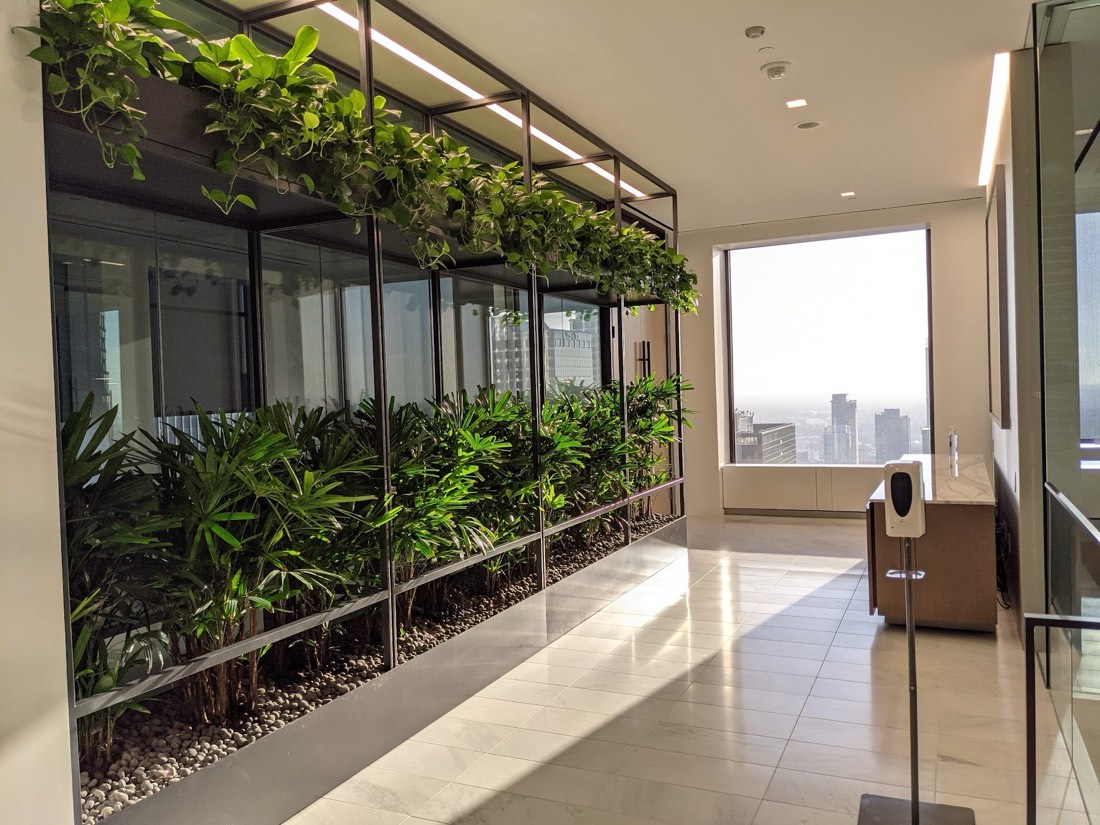
Measure it. A free light meter app on a phone is close enough for this. Read it at the plant, not at the window, around two in the afternoon. Then read a plant in the same building that is doing well. The gap between those two numbers explains most of what you are looking at.
How far a plant sits from the glass usually matters more than which room it is in, which is why the same plant holds on one side of a floor and thins out on the other.
Sources: office and lobby light levels, the IESNA Lighting Handbook as tabulated by Archtoolbox (2021). The 50 foot-candle floor, Colorado State University Extension, PlantTalk 1352.
What is your building doing when nobody is there?
From Friday evening to Monday morning there are roughly 65 hours when nobody is in the room. Whatever the building does to your plants in that stretch, nobody sees it happen. It repeats every week for a year, and one Monday somebody finally notices the plant.
The big variable is temperature. The energy standard most commercial buildings are designed to allows an empty office to drift to around 90F while it is unoccupied. Your building may or may not run that way, and most tenants have never asked. It is worth asking: a tropical plant in a room that drifts that warm over a 65 hour weekend, with dry soil, has had a very different weekend than you assumed.
- The vent above it. Hold a tissue at the top of the plant. If it moves, the plant is sitting under a vent that blows on it. Damage on one side only, or soil that dries much faster than the same species across the room, is a vent problem, not a watering problem.
- The weekend setback. Ask whoever manages the building what the thermostat does on a Saturday and over a holiday closure. Plants that look fine every Friday and tired every Monday are telling you about the weekend.
- The glass behind it. A plant against west-facing glass in a building with the air conditioning off for a long weekend gets afternoon sun and no cooling at once.
The 65 hours is plain arithmetic, Friday at 7pm to Monday at noon. The unoccupied temperature comes from published summaries of ASHRAE 90.1. Read it as what the standard permits, not as a description of your building.
Who is actually responsible for this plant?
Treat this one as a diagnosis, not a lecture. Put a rough date on when the plants started to go, then ask who left the company, changed desks, went on leave or changed roles in the month or two before it. Your plants started dying in March? Who left in February?
When nobody owns the job, the failures come in two opposite shapes and both are fatal. In the first, nobody touches it for three weeks. The soil pulls away from the side of the pot, the pot is light when you tilt it, and the plant wilts but perks up a few hours after a drink.
In the second, six people water it in one week because it looked thirsty to each of them. The soil is wet on top, the lower leaves yellow, and the soil smells sour. Yellowing that starts at the bottom and climbs while the stems go soft is root rot, and by then it is usually past saving.
Neither failure is about carelessness. Both are what happens when a job has no name attached to it. If you have quietly become the person who waters the plants, we wrote a page on who ends up with this job in an office and what it really takes.
Is it the plant, or was it the wrong plant?
Some species fail in offices no matter who looks after them. The three we see fail most often are the fiddle-leaf fig, calathea and ferns. That is not a study, it is what we see standing in the room. A fiddle-leaf fig drops leaves after any change at all: a new thermostat schedule, a move across the room, a different person watering it. Calathea and ferns want humidity a Los Angeles office does not have, and they go crisp at the edges while the soil is still damp.
These plants can live indoors here, but they need a specific spot and a steady routine, and an office is the least steady room most of them will ever stand in. A fiddle-leaf fig in the glass of a break room can be a good plant for years. The same tree twenty feet from the window is a countdown.
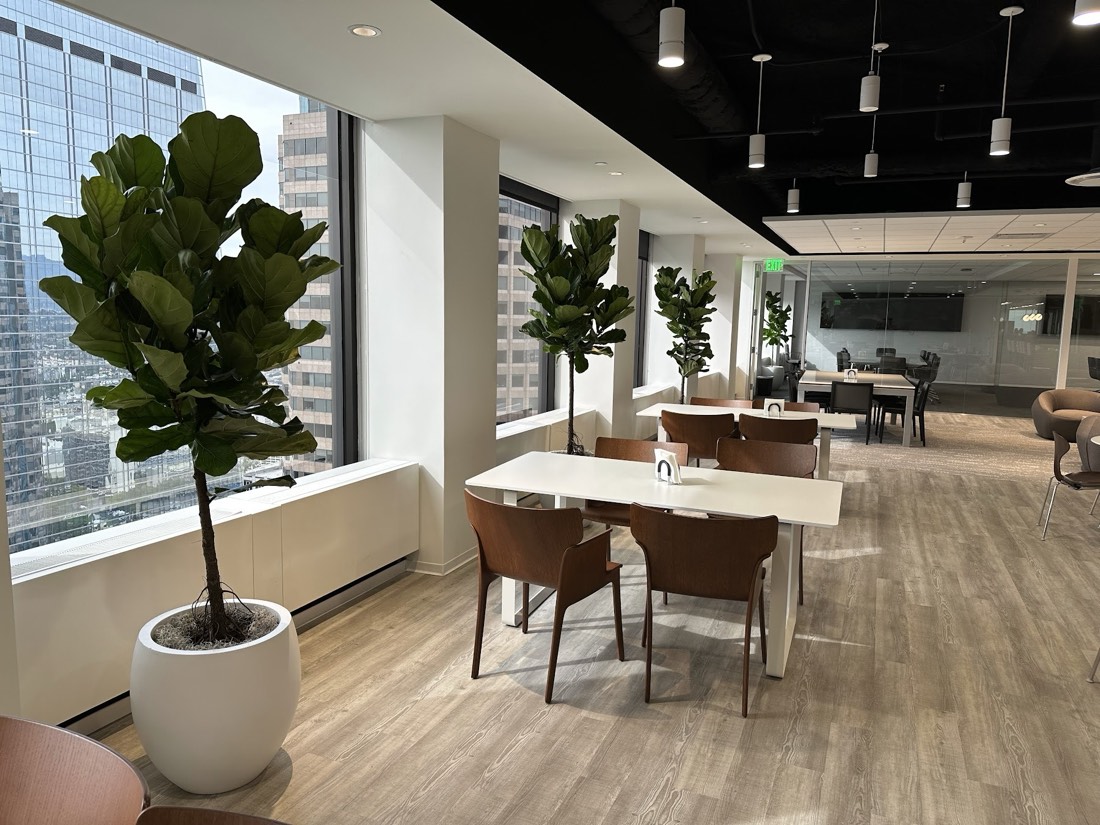
Swapping species will not rescue a spot that has already taken two plants. If a corner has killed two, the corner is the problem. Read the light there before anything else goes into it. The detail on which species hold in a dim office and which do not is in our care guide.
The Los Angeles ones: December, Santa Ana winds, hard water
Three conditions here are local enough that a plant book written somewhere else will not warn you about them. All three are things the room does to the plant, so they show up as damage nobody thinks to blame on the building.
- December. It is the driest stretch of the year and it carries the longest closures. A plant that was holding on through the autumn often gives up over the holidays, and the two weeks nobody was in the building is the reason.
- Santa Ana winds. They push indoor humidity very low, and they reach lobby and entry plants first because those doors keep opening. Brown, crisp leaf tips while the soil is still damp is about the air, not the water. Watering more makes it worse.
- Hard tap water. A white crust on the soil surface and around the pot rim is months of minerals left behind, not a disease. It builds slowly, so it is easy to miss until the leaf edges start to burn.
These three are our own observations from routes across Los Angeles and Orange County since 1986, not statistics. Our care guide carries the full local list and what to do about each one.
Gnats, sticky leaves and webbing: what each one is telling you
These three turn up constantly, and people reach for a spray for all three. Only one of them is really a pest problem in the first place, so it is worth knowing which one you are looking at before you buy anything.
- Small flies that lift off the pot when you knock it: fungus gnats. They breed in soil that stays wet, so they are a watering symptom before they are a pest problem. A spray kills the adults you can see and changes nothing, because the next batch is already in the soil. Letting the top of the soil dry out between waterings is what actually ends it.
- A sticky film on the leaves, and often on the desk under them: something is feeding above it. The stickiness is honeydew, which means an insect is drinking sap further up the plant. Turn the leaves over and look where the leaf joins the stem for small brown bumps or white cottony specks. That is where they sit, which is why people wipe the sticky leaf for weeks and never find the cause.
- Fine webbing at the leaf joints: spider mites. The leaf usually goes dull and finely speckled before anyone sees a web. They do well in warm, dry air, which is why they turn up near a heat source and during a Santa Ana week.
The part that matters more than the name: the second and third of those move from plant to plant in a warm room. So the question is never only this plant. It is the ones standing next to it, and the ones on the other side of the partition sharing the same warm corner. Caught in the first week it is a wipe-down and a treatment. Caught in the second month it is usually a plant you are replacing, and sometimes three.
If a plant is badly infested and already weak from a spot that was too dark for it, that is two problems at once, and it is more honest to call the plant finished than to spend three months nursing it.
What is worth reviving, and what is not
Some of this is fixable in a few weeks. Some of it is finished. We would rather say which is which than sell anyone a treatment for a plant that is already gone.
Usually worth the effort
- Tired but intact. Dusty leaves, no new growth, a salt crust on the soil, growth leaning one way. That is care and placement. It comes back with a clean, a feed, a trim and often a move of a few feet toward the glass.
- Bare but firm. A plant that has dropped a lot of leaves but still has firm stems or canes, and firm pale roots, has a plant left in it. Dracaena canes push new heads after being cut back.
Usually finished
- Soft at the base. If the stem gives when you squeeze it near the soil, or the roots are brown and smell sour, that is root rot and the plant is gone. Changing the soil does not undo it.
- Bare in a dark corner. A plant that has lost most of its leaves in a spot reading below 50 foot-candles will not grow them back there. There is no care routine for light that is not in the room.
- The second plant to die in that spot. Buying a third identical plant for the same corner is money spent twice.
A supplier in this trade published a working estimate of how much of a plant inventory gets replaced over two years, sorted by light: 50 to 60 percent in low light, 30 to 40 percent in medium, 10 to 20 percent in bright. That is a practitioner's estimate rather than a study. In that estimate it is the light level, more than the species, that moves how often somebody is buying another plant. Reviving a plant that sits below 50 foot-candles is buying the same plant twice.
That is the honest way to think about the money. If you are weighing keeping the watering in-house against handing it over, the labor is the small part of the arithmetic and the replacements are the large part, which we work through on the page comparing doing it yourselves with hiring a service. What a maintained program costs here is on our page on what office plants cost in Los Angeles.
Replacement rates by light level: NewPro Containers, published September 2026. A practitioner's estimate, not a study.
Already have a plant service and they are still dying?
Plants declining under a paid service is worth a conversation, and it is usually about something that changed rather than anyone's competence: a new HVAC schedule, a wall that went up, desks moved away from the window, or a plan that never included replacement.
If you can get a question to whoever books the service, three are worth asking: does our plan replace declining plants free, what does the light read at the plants that keep failing, and what would they move if these were theirs? A good answer will either fix it or say plainly that the spot cannot hold a plant.
If it turns out the answer is to change service, existing plants are assessed at the walk-through and the proposal says up front which ones can be carried, which is how a takeover works without a gap in visits.
Still not sure which one you are looking at?
If you cannot tell from here whether it is the light, the water, the vent or the roots, send us a photo and we will tell you what we see.
Send us a photo
Tell us about the space and send a few pictures. We will tell you what we see, what would fix it, and roughly what a service costs. No visit needed.
You will hear back from a real person by the end of the next business day.